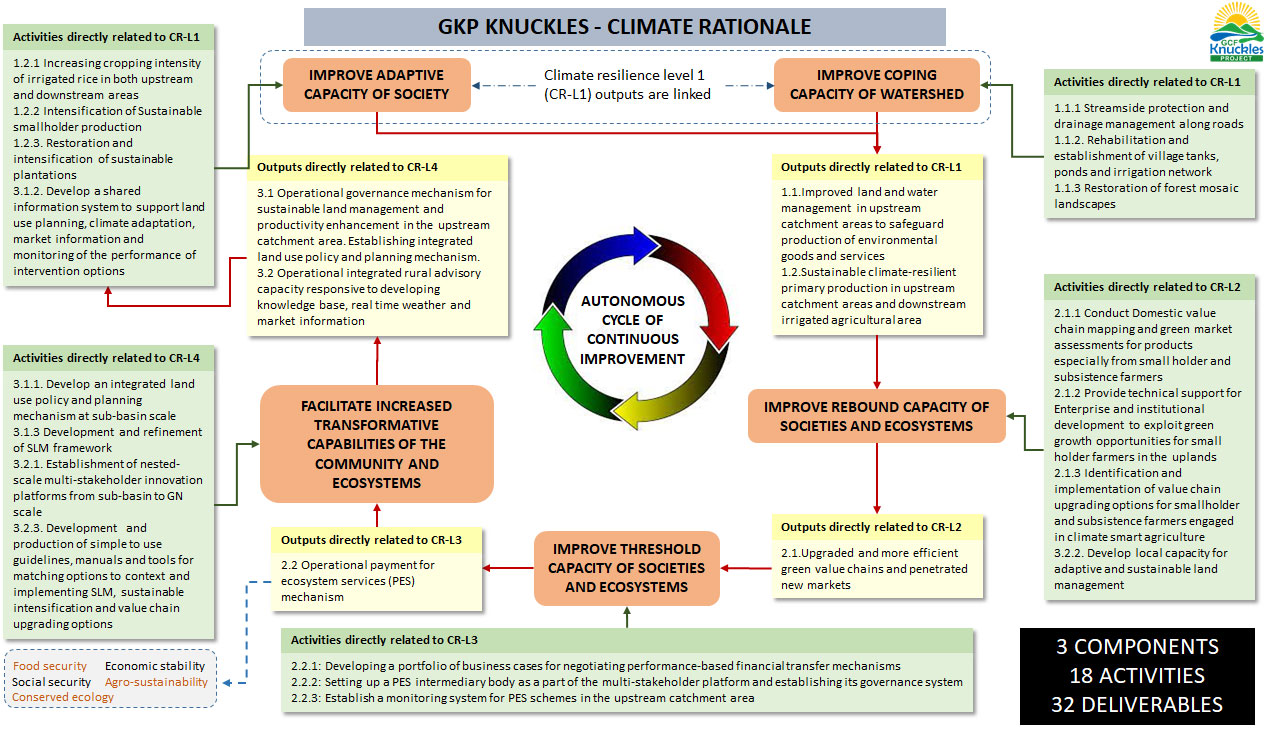
The GCF-Knuckles project aims to build resilience of climate vulnerable families in both upstream and downstream areas. Towards this ultimate goal, it will use a constellation of targeted activities that will improve the adaptive, coping, rebound, threshold and transformative capacities of both human and natural systems targeting primarily, the Knuckles water fountain. The foundation rationale, while steeped in evidenced climate science is simple enough: “Ensure the water volume and water quality of the Knuckles Upper Watershed (KUW) to optimize water availability to downstream communities”. In order to achieve that, the project will execute 18 macro-level tasks that take a holistic approach to harmonizing the human-environment interface.
Options by context
In a terrain as fractured and diverse as the KMR, it is obvious that no one size will fit all terrains, peoples and ecosystems when it comes to building climate resilience. Therefore, innovatively, the project seeks to fine-scale understand the dynamics at play within mezzo-catchments and micro-catchments and design treatment strategies that will achieve project goals within those unique geographies. Recognizing that this is a formidable challenge, the PMU has established one of the strongest scientific teams gathered in recent times to support in the decision making process.
Adaptive management
Central to the options-by-context approach is that management of all aspects of the project follow the principle of adaptive management. It is an intentional approach to making decisions and adjustments in response to new information and changes in context. This most certainly does not mean changing the goals of the project. Rather, it is changing the paths that will be taken towards achieving the goals as each new situation arises during as the project progresses. This gives the PMU, field staff, partners and stakeholders the flexibility required to optimize the various development pathways at the micro-terrain level to streamline project execution and optimize project impacts.
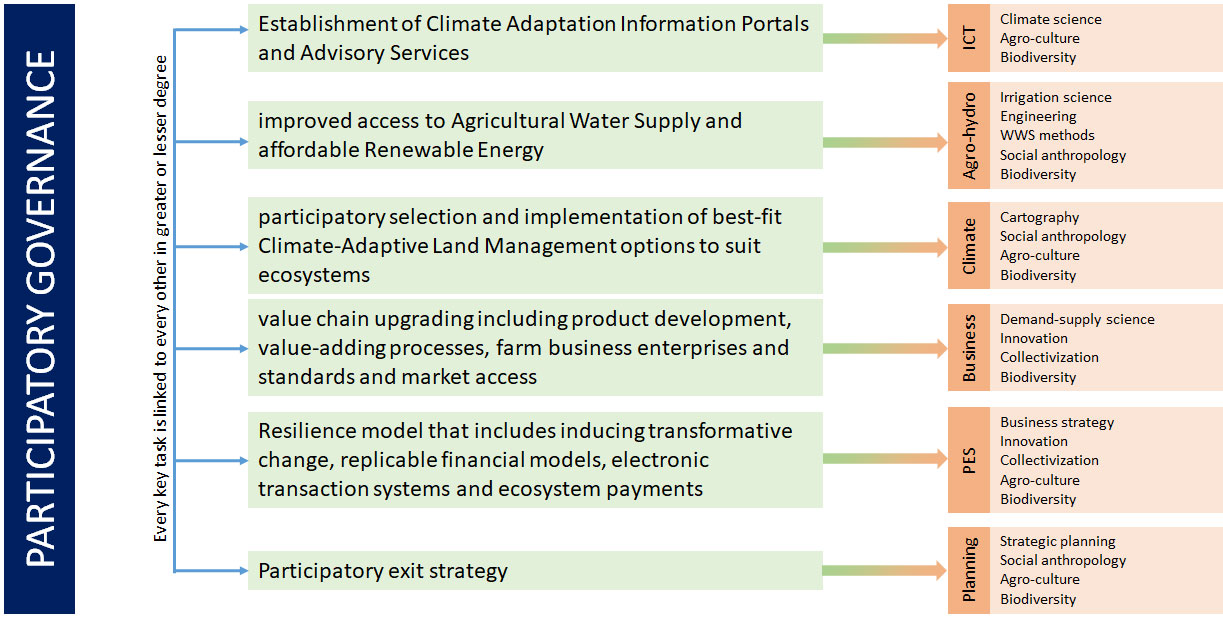
Key tasks, links and areas of expertise required
The GKP Knuckles project is one of the most complex, most challenging and yet, most exciting projects every attempted by the government of Sri Lanka. The multiple action facets of the project in protecting stream sides and roadsides, improving the forest mosaic, intensification of production of rice, smallholder plots and plantations, optimizing value chains, creating systems to pay for ecosystem services and building capacities requires many types of expertise to be brought to bear on the project as shown in the diagram.