
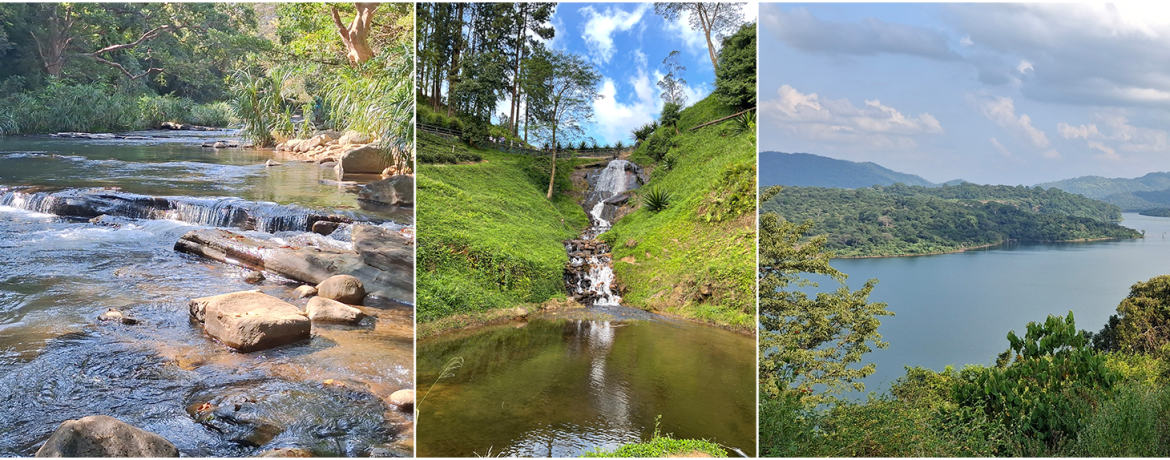
“How does one hate a country, or love one? Tibe talks about it; I lack the trick of it. I know people, I know towns, farms, hills and rivers and rocks, I know how the sun at sunset in autumn falls on the side of a certain plowland in the hills; but what is the sense of giving a boundary to all that, of giving it a name and ceasing to love where the name ceases to apply? What is love of one’s country; is it hate of one’s uncountry? Then it’s not a good thing. Is it simply self-love? That’s a good thing, but one mustn’t make a virtue of it, or a profession… Insofar as I love life, I love the hills around me, but that sort of love does not have a boundary-line of hate. And beyond that, I am ignorant, I hope.” – Ursula K. LeGuin – The Left Hand of Darkness
That quote read for the first time when I was 13 is my favourite from a science fiction writer and a nice segue into this little musing. How indeed can one look at nature and think, “this part of it is mine and that part of it is yours?” How can I state “I love my part and hate your part?” “How can I claim “I won’t touch your part if you won’t touch my part?” Nature had never worked in that way and never will. The expansion and contraction of its phenomena are driven by an order that humans have always had a problem with simply because our desire to cleave things clashes with nature’s desire to unify things. Our desire to unbalance things conflicts with nature’s desire to balance things.
Still, we may be able to live within this foolishness but for a massive problem related to what I choose to call “large swath commons” that are vital for the existence of every sentient being on the planet. These are natural phenomena that refuse to fit into our societal parcelling. Forests that straddle multiple nations, rivers that flow across continents, air that swirls around the world. The minute we created our little ownership spaces, we also created a mighty problem in the use of things that refuse to be limited by those spaces.
We have managed to some extent to deal with tree cover because it is stationary and may be thought of as belonging to a set of districts, provinces or nations. So too, we have come to terms with air through global covenants although for the most part, it is still quite difficult to overcome problems because there is precious little we can do if one set of people poisons it and another set of people are sickened by the pollution”. Rivers are different to both because they flow from one part of the world to another part of the world through limited, well defined channels. The fact that rivers are self-limiting in their movement makes us feel sufficiently able to want to control its ownership. We feel that we have a chance while it is still flowing within our own “ownership boundaries” be those districts, provinces, states or nations, to claim that “this water is ours”. We can believe that we can store all of it, we can drink all of it, we can irrigate land with all of it, we can pollute all of it. In short, we can prevent its use by those living in geographies it flows into.
Obviously, this type of thinking creates instantaneous conflicts. Such was the threat of “water wars” that for the first time in 25 years, a global water summit was held in 2023 while one of the commencement roundtables at COP 27 was about this very problem. The theme for this year’s world water day is “Water for Peace”. In this lead up it can be seen how alarmed the global leadership is that unless water conflicts are resolved the entire world would be a grave danger of a planet-wide conflict stemming from it. In essence, all of these moves urges cooperation between those who have to deal with problems arising from sharing trans-communal, transnational, transcontinental still and flowing water bodies.
It is a difficult task with very little real knowledge to go on because all we have to work with are manmade instruments such as laws, covenants, conventions and commitments all of which have to do with external bodies regulating very personally important things. In most arenas, people can – and do – get by with these types of frameworks but not when it comes to natural things that exist and work outside of human law. To get by and get along with nature, we must be reminded of a societal custom (a rule if you may) that we have been told to forget. We have been ordered to forget. We have been forced to forget. We have been driven to forget.
It is this: Every individual in society who uses sometime nature gives must make sure that only what is absolutely necessary at that moment is used, that some act must be performed to restore what was taken and that that everything excess that is not used is left in pristine condition for every other individual to use.
It is a truism surely. But not for those who want to give excuses for taking more than they want saying “I need this for electricity, for irrigation, for drinking, for powering my fizzy drink business, for lubricating my processed foods enterprise”. What they are actually saying is this: “I am so full of the desire to make sure that resource is mine so that I can feed my need that I do not care whose desperate need for a few bits of this or that are violated.
The reason why our peopled world that is driven by selfish motives has tried its best to forget such a custom is because it is anathema to greed, covetousness and ownership. Therefore, it had to be cauterized from our very souls. That effort succeeded to a large extent. That is why we have our nations, our provinces, and our itty bitty ideas of who owns what and how much of it for a fleeting moment, a fleeting month, a fleeting millennium. That is why we have such trouble trying to come to terms with that fundamental commonality of large swath commons because we have been told so persuasively, so pervasively, so brutally to ignore it. That is why every externally regulated action from agreements to sanctions on the fair use of commons will fail – sooner rather than later. Regardless of who we think we are, we, going down this route of covetousness will become but shadows. Swept away on that greatest of moving rivers – time.
However, at least from a Sri Lankan perspective, hope is not lost.
Through the GCF funded FP124 project, the Ministry of Irrigation and its partners will use a mix of traditional customs and modern laws with strong community ownership of processes to establish water-equity and thereby “peace through good water-use practices” across all river basins in the Knuckles region upstream and the Malwatu Oya and yan Oya downstream. Understanding full-well the subtleties of the water dynamics of one of the most critical watersheds, the project will optimize water availability for both human systems and natural systems as well as optimize water use with the primary focus being to balance the human-environment interface and thereby, reduce conflicts between human beings and natural biota as well as reduce conflicts in the ownership and use of natural resources with the focus being on managing the waters generated in the Knuckles as well as the other areas fed by that water fountain.
Taking a holistic approach to the effort, the project will make sure that the watershed itself is regenerated, water volumes are improved, water quality is improved, water recharge and availability is ensured, water pollution is minimized and water sharing is optimized.
It is a challenging task but one of the most important ones undertaken by the government in recent times. It will employ a whole-of-community approach to resolving the problems with strong community stakeholder ownership of the effort. There is the strongest possible political will and official commitment to ensure that this effort succeeds over the next six years and that the practices that worked during implementation can be replicated across Sri Lanka. The government understands that ensuring water security is tantamount to ensuring the security of all sentient beings in the country and that secure living things do not have any reason to fight other living things and peace would be the result of this foundation level action on water.
Arjuna Senevirathna
Leave A Comment