
Restoration must be a part of the socio-cultural and socioeconomic ethos of peoples
Since the early 1990s when the world started to become dimly aware that not all was right with itself such words as degradation, environment, balance, harmony, climate, green, blue have come to the fore front of human thinking. Some of these stayed while others became less in vogue. Those that stuck around are, in hindsight, words that have some advantage to those who use them regularly. This we know by hindsight through participation at endless COPs, aid debates and development confabs. Granted, some good has certainly come out of these but not enough and most certainly not fast enough. We are past the stage where we can fiddle while the world literally burns down.
Every year, we have a world environment day. This year, the theme centers on the theme of land restoration, desertification and drought resilience. These are obviously areas that the world must address urgently. This is because these are not phenomena that came into being by one or two rogues or collectives or nations. These became through our collective carelessness towards our planet and our collective, greed-driven desire and design for individual ownership of “must-share” resources.
Since this problem was created together, then, obviously, it must be solved together. That is the problem. The human foundation of working with each other for collective good has been systematically cauterized from our very DNA since the advent of the Industrial Age. We do not have another 400 years to reverse our thinking or our ways of living. We have, at most, just 20 years. This should give us perspective on the massive collective effort we must engage in with just one goal – the stability of every living thing on earth even though we know, with absolute certainty, that it will have to be done at great cost to ourselves as individuals. That is the only way of turning around the effects of previous negative karma.
The simplest way of articulating the response is to say “If we carefully, thoughtfully, insightfully manage our water and land resources, we can restore the planet, we can roll-back desertification, we can slowdown the effects of drought”. The keyword here is “we”. It must be a whole-of-area, whole-of- province, whole-of-nation effort.
First, we must understand that we must, as swiftly as possible, reject life-as-usual at every level of society, of modern culture, of modern business, of modern ideas of what constitutes civilization and of modern ideas of what achievement is all about. Next, we must be strong enough and brave enough to espouse holism into are life-fabric. Finally, we must apply that holism to the restoration of our water and our lands. Restoration cannot be done through linear thinking. It is not only planting trees. It is only not shoring up riverbanks. It is not protecting sensitive ecosystems. No. It is a intermesh of all of those overarched by the one key ingredient that overarches all and will give sustenance and continuity to all of those efforts. That one apex factor is the restoration of the human mind to human goodness. Is it the understanding that selfishness will first kill the self before it kills everything else. It is the insight that dictates that what I do now must, largely be for the good of people yet to come and not one’s self. It is the great caring that drives us to be kind, first to ourselves and then to every single sentient being, every rock, every piece of earth, every tree, every burst of air, every drop of water. It is in the restoration of the idea of restorative and regenerative lifestyles into are very ethos.
The science is certainly there but where is the heart? Where is the soul? We cannot solve this problem through just the science because science is at best, a series of intermeshed rational ideas and at worst as story. When looking at land degradation, desertification, drought resilience, we must be very aware that until and unless the science is infused and saturated with the human desire for restoring humanness to human beings, it will remain in the realm of fantasy. To do otherwise, to bring about lasting change, requires a far harder, far tighter understanding of the need to balance and harmonize science, human and natural societies and environments and what we mean by that much-maligned and much-questioned word “development”.
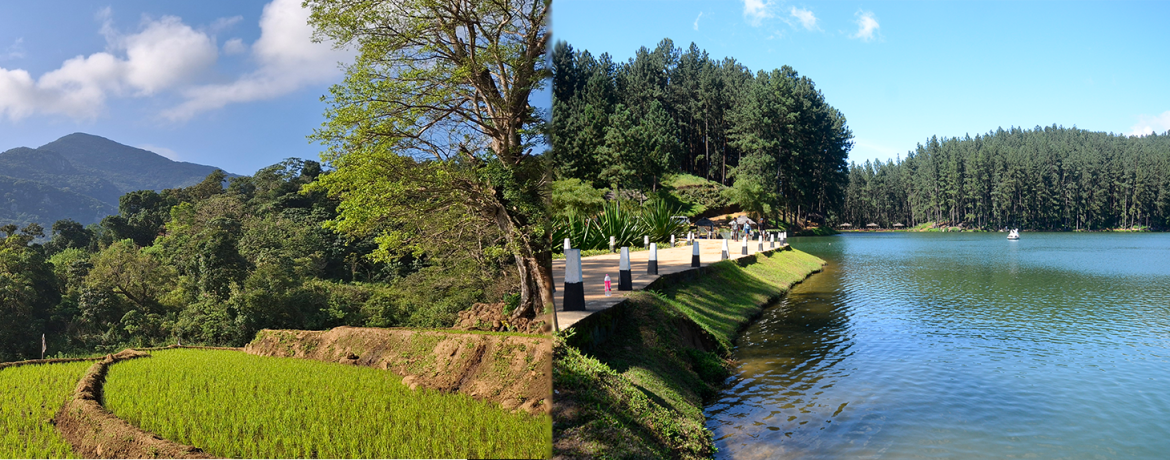
The FP124 project in that critical water fountain that is the Knuckles Mountain Range is designed for exactly that purpose. The treatment landscape is bioisolated, highly fractured and a key water generation area. It is an area that is comparatively sparsely populated by human beings and vastly populated by unique natural biota. It is a region whose health will determine the quality of lives and livelihoods millions of people living downstream. It is also one of the most vulnerable to external threats ranging from climate all the way to myopic, hyperopic or astigmatic development ideas.
The task of reversing land degradation and drought in that area through the project is by roping in over 75 state agencies, area communities, civil and private agents and policymakers. Whole-of-area effort means that these players in this critical terrain must come together as one. It is not an easy task by any measure. At times, it may look like a thankless task as well. However, every single individual, every single stakeholder, every single community member shall know, as the project progresses that they have been a part of one of the greatest efforts undertaken by any country in the sub-region to harmonize the human-environment interface and give real meaning to the idea of restoration, rehabilitation and resilience in line with the three pillars of this year’s World Environment Day theme.
Arjuna Senevirathne
Leave A Comment